
Your cart is currently empty!

Coaching: Definition, Types, and Models
Introduction
Coaching is a process aimed at helping individuals achieve their personal and professional goals through guidance, raising awareness, and fostering development. In this article, fundamental concepts, approaches, and models of coaching will be comprehensively discussed, supported by visuals.
Table of Contents
- Definition of Coaching
- Types of Coaching
- Coaching Approaches
- Coaching Models
- References
Definition of Coaching
Coaching is a structured process that helps individuals assess their current situation, set goals, and develop strategies to reach those goals. The International Coaching Federation (ICF) defines coaching as a “partnership that deepens thinking and creative processes, aimed at maximizing the personal and professional potential of the individual”【1】.
Types of Coaching
Coaching is applied in various types to meet different needs:
- Life Coaching: Helps individuals achieve their personal goals.
- Career Coaching: Maps out professional paths.
- Executive Coaching: Develops leadership skills.
- Performance Coaching: Focuses on performance-enhancing goals.
- Academic Coaching: Supports students in their learning processes【2】【3】.
Coaching Approaches
Coaching can be applied in different approaches, depending on the needs of the individual:
- Solution-Focused Coaching: Focuses on solutions rather than problems.
- Positive Psychology Coaching: Focuses on discovering the individual’s strengths【4】【5】.
- Cognitive Behavioral Coaching: Aims to change negative thought and behavior patterns【6】.
- Person-Centered Approach: Provides a safe environment for the client to realize their own potential【7】.
- Gestalt Approach: Helps the client make connections between the past, present, and future【8】.
- Narrative Coaching Approach: Helps individuals rewrite their life stories【9】.
- NLP Approach: Uses neuro-linguistic programming techniques to optimize thought and behavior processes【10】.
Coaching Models
Below are some commonly used models in the coaching process, with their explanations and the approaches they are based on:
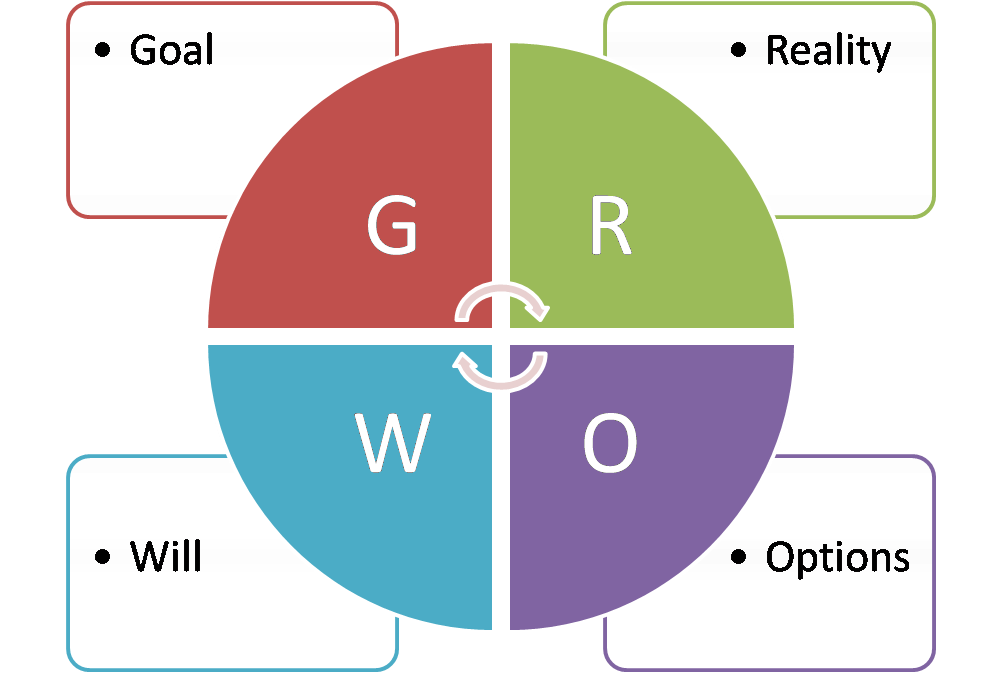
1. GROW Model
- Explanation: Includes stages of Goal setting, Reality assessment, Options generation, and Will to act.
- Goal: Define clear objectives.
- Reality: Explore the current situation.
- Options: Generate actionable strategies.
- Will: Commit to actions and follow-up.
- Approach: Solution-Focused Coaching and Cognitive Behavioral Coaching principles.
- This model focuses on structured problem-solving and goal achievement.
- Visual:
2. TGROW Model
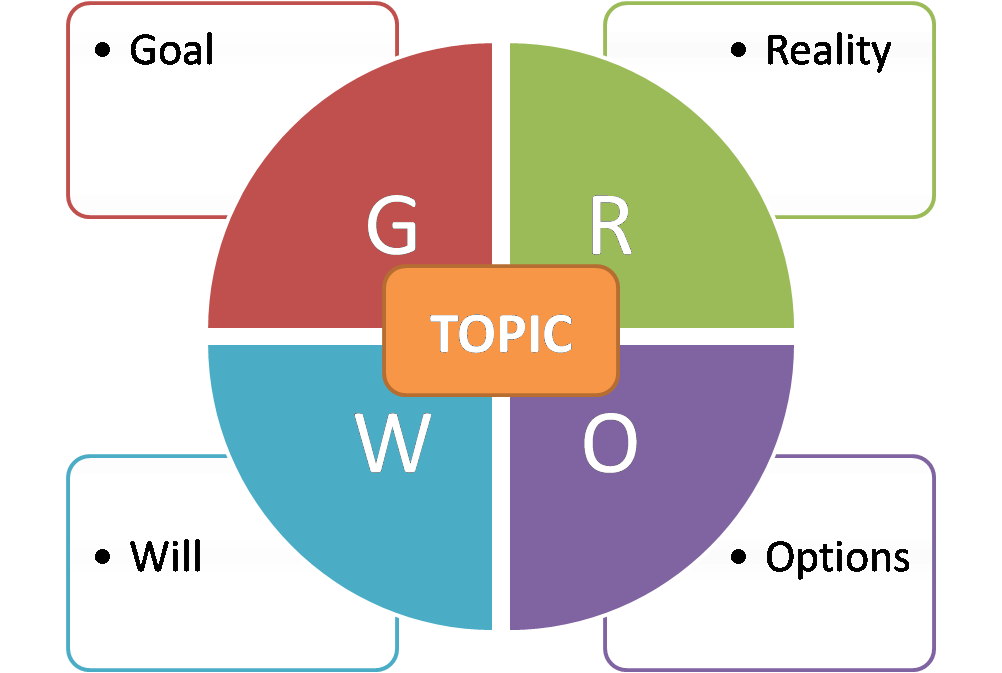
- Explanation: Adds a Topic definition stage at the beginning of the process, in addition to the GROW model’s stages.
- An extension of GROW, it adds:
- Topic: Establish the discussion’s primary focus.
- Followed by Goal, Reality, Options, and Will.
This ensures clarity in the coaching context.
- Approach: Solution-Focused Coaching and Positive Psychology.
- Visual:
3. CLEAR Model
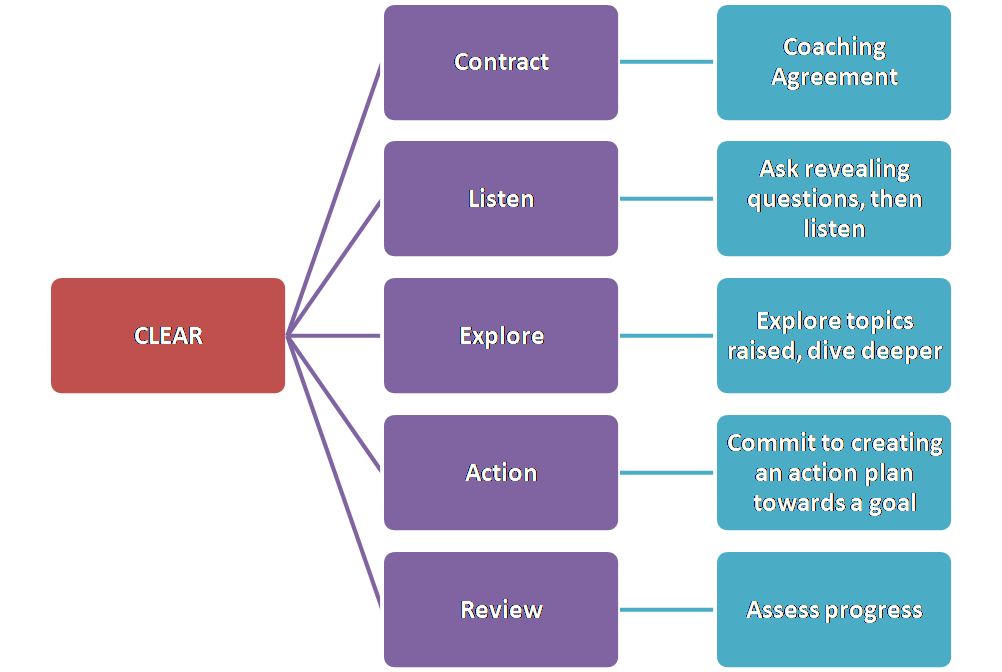
- Explanation: Includes stages of Contracting, Listening, Exploring, Action, and Reviewing.
- Contracting: Set expectations and goals.
- Listening: Deep, non-judgmental listening.
- Exploring: Delve into challenges and opportunities.
- Action: Develop actionable steps.
- Reviewing: Reflect on outcomes and learning.
- It emphasizes a collaborative and iterative process.
- Approach: Gestalt and Person-Centered Approach.
- Visual:
4. Co-Active Coaching Model
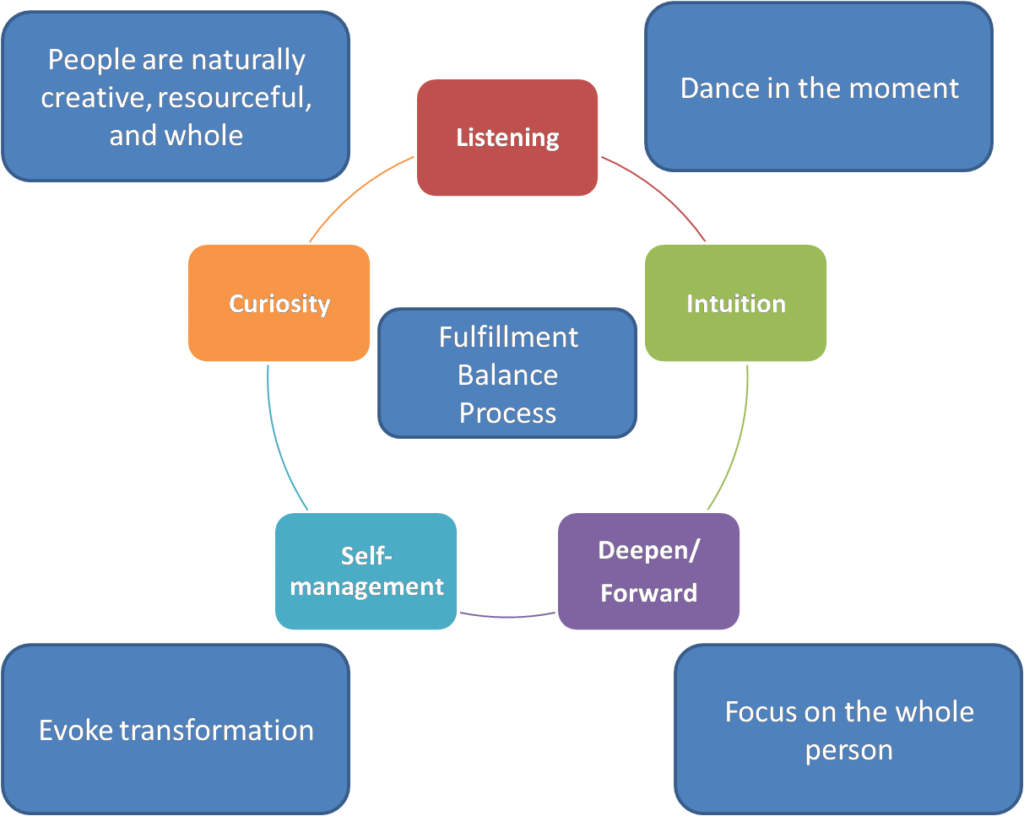
- Explanation: Establishes a strong partnership between the coach and the client. Aims to enhance personal awareness.
- Centered on the relationship between coach and client:
- Focuses on self-awareness, balance, and action.
- Builds on active listening and powerful questions.
Aims to empower the client through partnership.
- Approach: Person-Centered Approach.
- Visual:
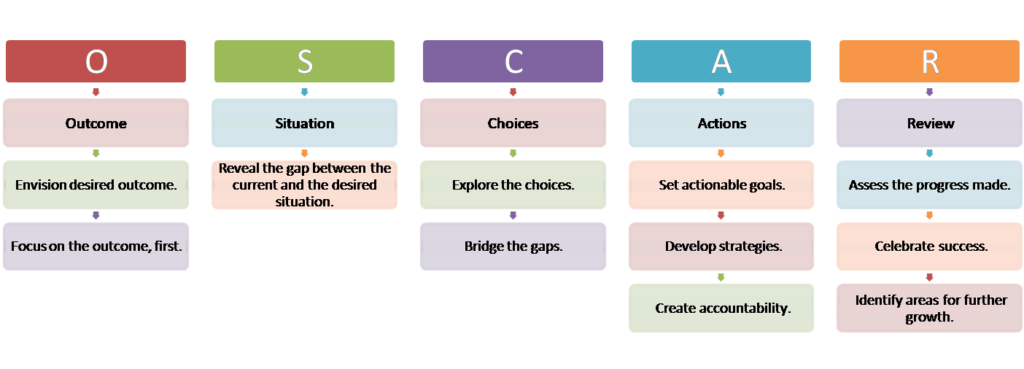
5. OSKAR Model
- Explanation: Comprises Outcome, Scaling, Know-How, Action, and Review steps.
- Outcome: Define desired results.
- Scaling: Measure current status.
- Know-How: Identify skills and resources.
- Action: Plan actionable steps.
- Review: Assess progress and learnings.
- Rooted in solution-focused coaching principles.
- Approach: Solution-Focused Coaching.
- Visual:
6. ERR Model
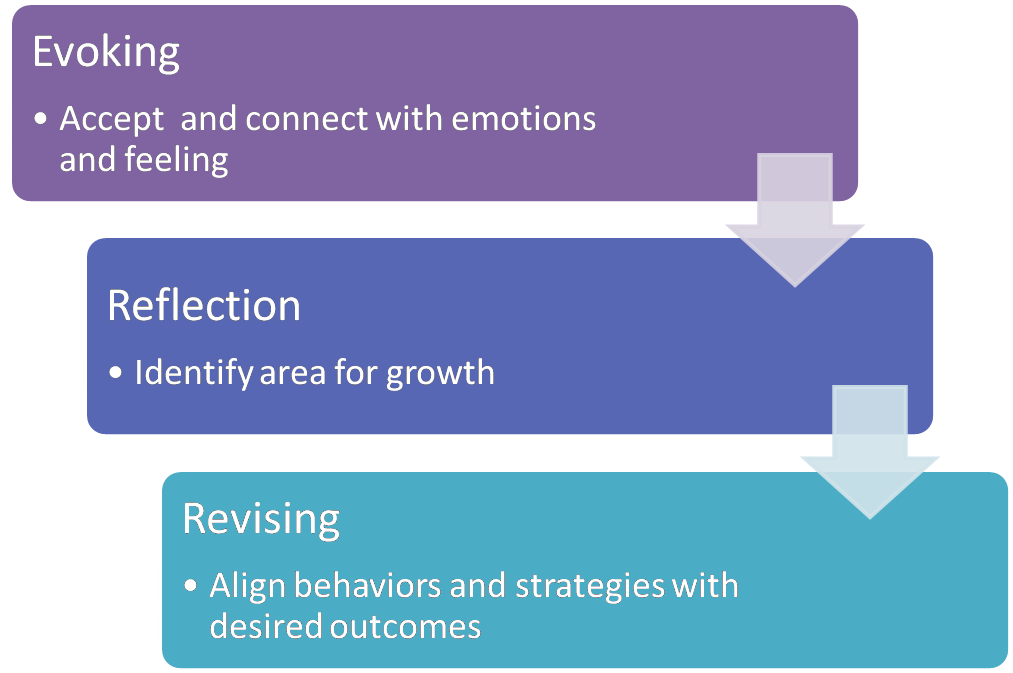
- Explanation: Includes Evoking, Reflection, and Revising steps.
- The ERR model of coaching focuses on three core steps:
- Evoking: Stimulating self-awareness and deep reflection in the client, encouraging them to connect with their thoughts and feelings.
- Reflection: Facilitating a deeper analysis of experiences, helping clients identify insights and areas for growth.
- Revising: Encouraging actionable adjustments to behaviors or strategies based on the reflections, aligning them with desired outcomes.
- Approach: Positive Psychology.
- Visual:
7. Johari Window
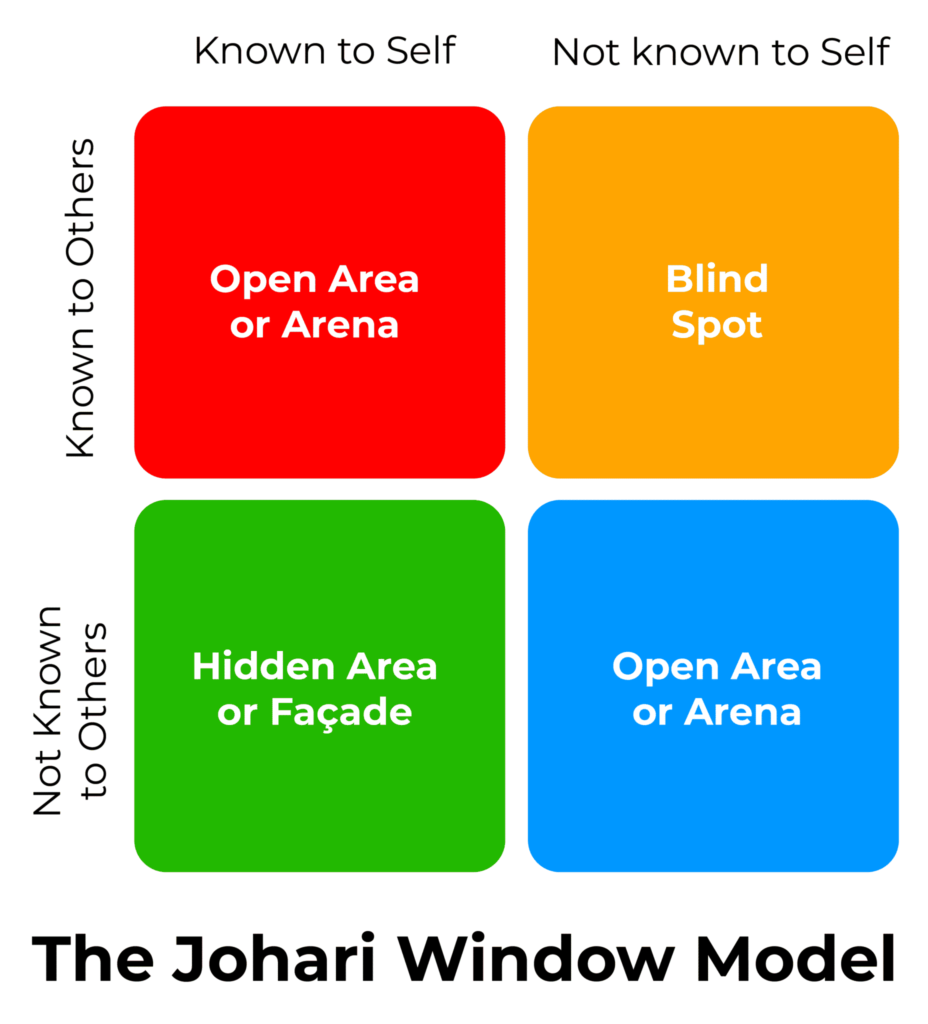
- Explanation: Focuses on helping individuals understand themselves and others.
- A tool for self-awareness and interpersonal understanding.
- Divided into four quadrants: Open, Hidden, Blind, and Unknown areas.
- Helps uncover blind spots and enhance communication.
- Approach: Person-Centered Approach and Narrative Approach.
- Visual:
8. Experiential Learning
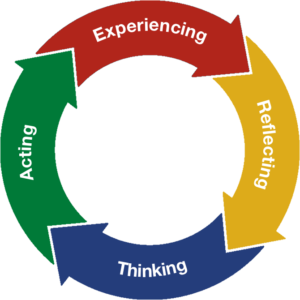
- Explanation: Encourages learning through experience.
- Emphasizes learning through experiences.
- Cycles through Concrete Experience, Reflective Observation, Abstract Conceptualization, and Active Experimentation.
- Promotes continuous personal and professional growth.
- Approach: Gestalt and Positive Psychology.
- Visual:
References
- International Coaching Federation. What is Coaching?. ICF Global
- Whitmore, J. (2009). Coaching for Performance. Nicholas Brealey Publishing.
- Grant, A. M., & Stober, D. R. (2006). Evidence-Based Coaching Handbook. Wiley.
- Biswas-Diener, R., & Dean, B. (2008). Positive Psychology Coaching. Wiley.
- Luft, J., & Ingham, H. (1955). The Johari Window: A Graphic Model of Awareness in Interpersonal Relations.
- Kolb, D. A. (1984). Experiential Learning: Experience as the Source of Learning and Development. Prentice Hall.
Posted In : Coaching
Author Details

Anna Riley
Members of Kanta Dab Dab, a band specialising in fusion of local Nepali and Western music elements, talk about their…
Follow Us
Popular Tags
Top Categories
- Coaching (1)
Leave a Reply